The Speaker’s Blueprint | Part 1 of 8.
You Have a Story. But Do You Have a Message?
By Women Seen & Theodora Voutsa
You have a story.
You have probably lived through things that changed you, challenged you, surprised you, humbled you or forced you to become someone you didn't expect to become.
Maybe you built a company from nothing.
Maybe you led a team through a crisis.
Maybe you changed careers.
Maybe you failed spectacularly.
Maybe you succeeded and discovered that success came with a set of problems nobody had warned you about.
Maybe you spent twenty years becoming an expert in something that nobody else understands quite the way you do.
And at some point, someone has probably told you:
“You should speak about this.”
But here's the problem.
Having a story isn't the same as having a message.
And having a message isn't the same as knowing how to communicate it.
That distinction is where great speakers begin.
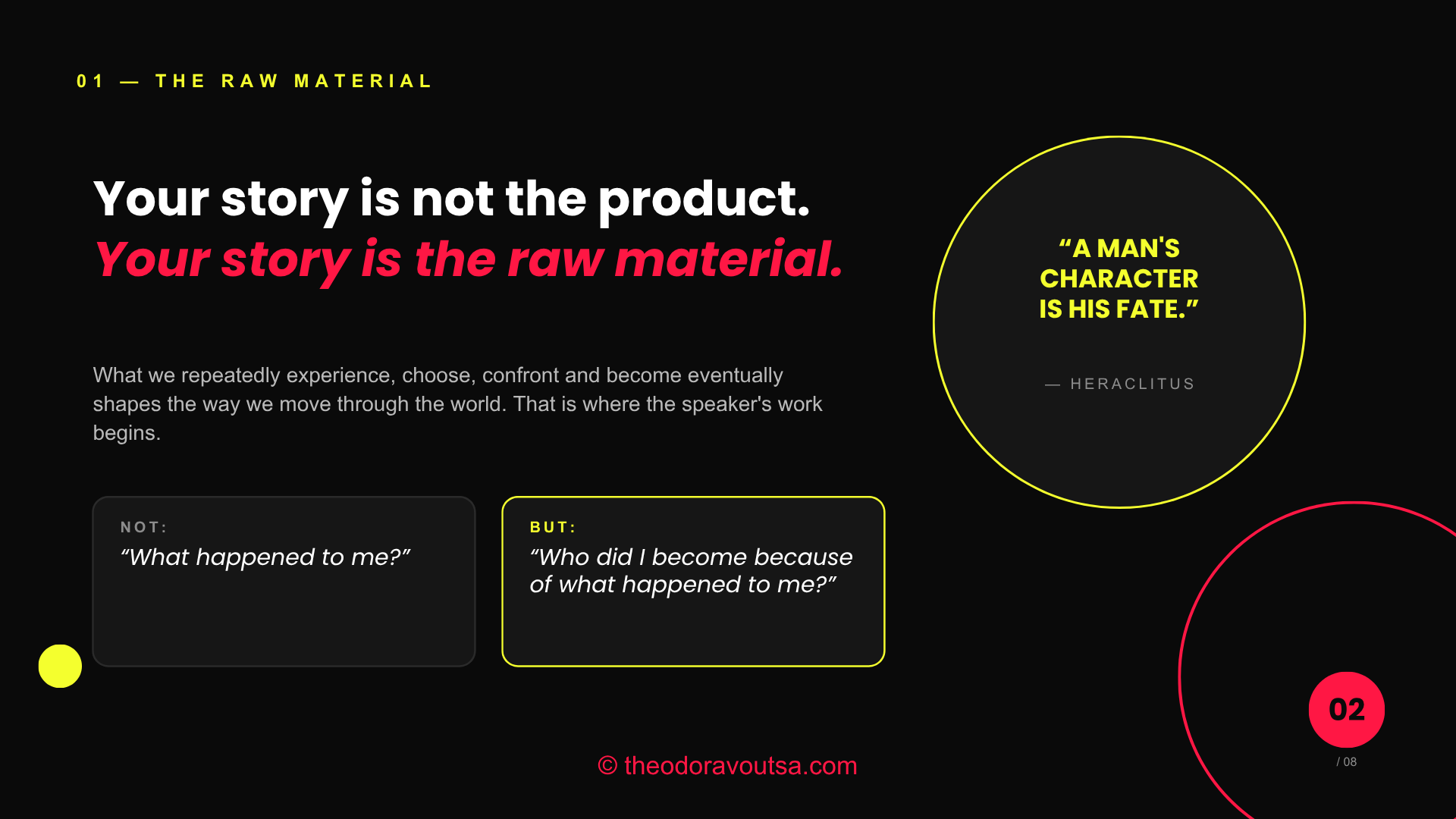
Your story is not the product.
Your story is the raw material.
The ancient Greek philosopher Heraclitus wrote:
“A man's character is his fate.”
It is a deceptively simple idea.
What we repeatedly experience, choose, confront and become eventually shapes the way we move through the world.
And that, to me, is where the speaker's work begins.
Not with the question:
“What happened to me?”
But:
“Who did I become because of what happened to me?”
Because the experiences of our lives don't automatically become wisdom.
We have to make meaning from them.
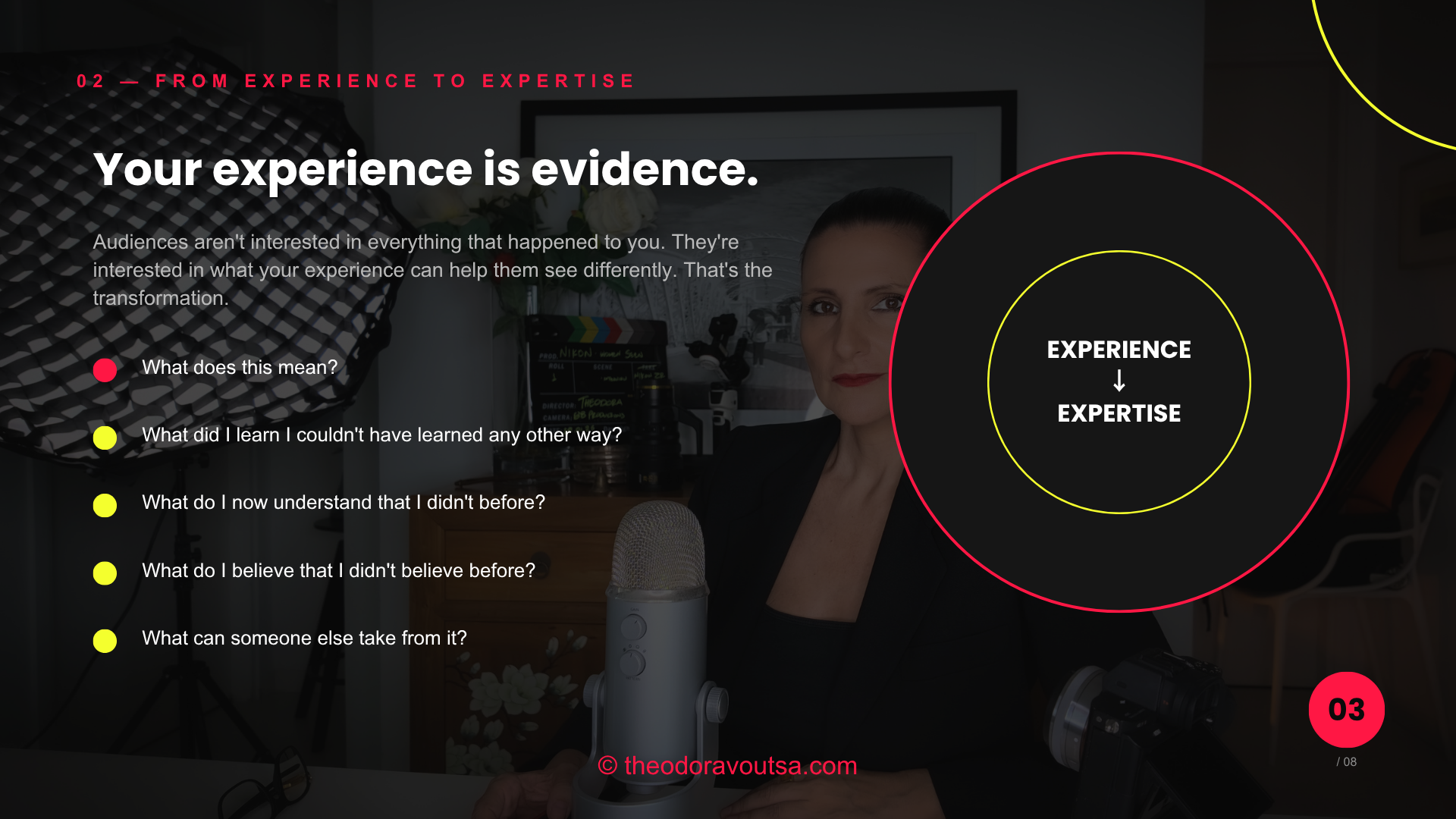
Your experience is evidence.
The mistake I see women make, particularly successful women, is assuming that because something significant happened to them, they automatically have a compelling talk.
They don't.
Not yet.
Because audiences aren't necessarily interested in everything that happened to you.
They're interested in what your experience can help them see differently.
That is the transformation.
You take the experience and ask:
What does this mean?
What did I learn that I couldn't have learned any other way?
What do I now understand that I didn't understand before?
What do I believe that I didn't believe before?
What did this experience teach me about leadership, ambition, failure, power, identity, business, creativity, relationships or being human?
And most importantly:
What can someone else take from it?
That is where experience starts becoming expertise.
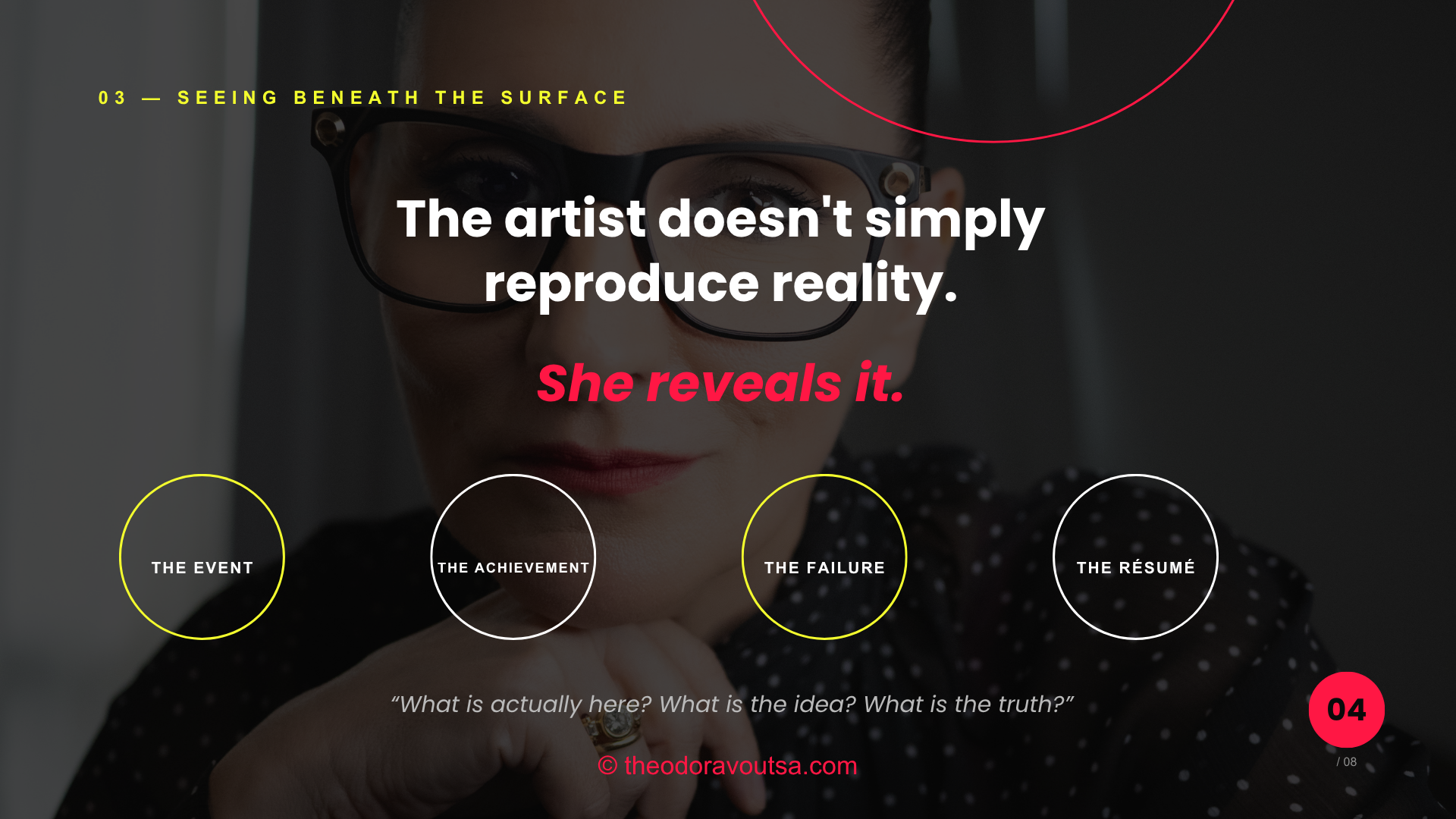
The artist doesn't simply reproduce reality. She reveals it.
This is one of the reasons I approach speaking through the lens of an artist.
Marcel Proust wrote that the artist's work is to look beneath “matter, experience, words” and perceive something different.
This is the essence I have learnt to live with since I was a child, raised in an artistic family.
Because isn't that what we are really doing when we turn a life into a body of work?
We are looking beneath the event.
Beneath the achievement.
Beneath the failure.
Beneath the résumé.
Beneath the story we have been telling ourselves about ourselves.
And we ask:
What is actually here?
What is the idea?
What is the truth?
What is the perspective that only this particular woman could have arrived at because she lived this particular life?
That perspective is where the value lives.
Think about Romeo and Juliet.
We all know the story.
We know the words.
We know what happens at the end.
And yet, centuries after Shakespeare wrote it, audiences continue to buy tickets to see it performed again and again.
Why?
Because we don't go to see the story.
We go to see someone's interpretation of the story.
Every actress who plays Juliet brings something no one else can bring.
She is unique.
She is one of a kind.
She may speak the same lines, in the same order, night after night. But those words pass through her convictions, herimagination, her experiences, her emotional life, her point of view.
And suddenly, we've heard those words before, but we hear them differently.
That is the power of interpretation.
And it is the power every woman brings to the stage.
You don't need to invent a story that nobody has ever heard before.
You need to find your way of seeing it.
Because nobody else has lived your life.
Nobody else has arrived at your convictions in exactly the same way.
Nobody else can interpret your experience through exactly the same lens.
That is why your story matters.
Not because it happened; but because you are the one who lived it and you are the one who can tell us what it means.
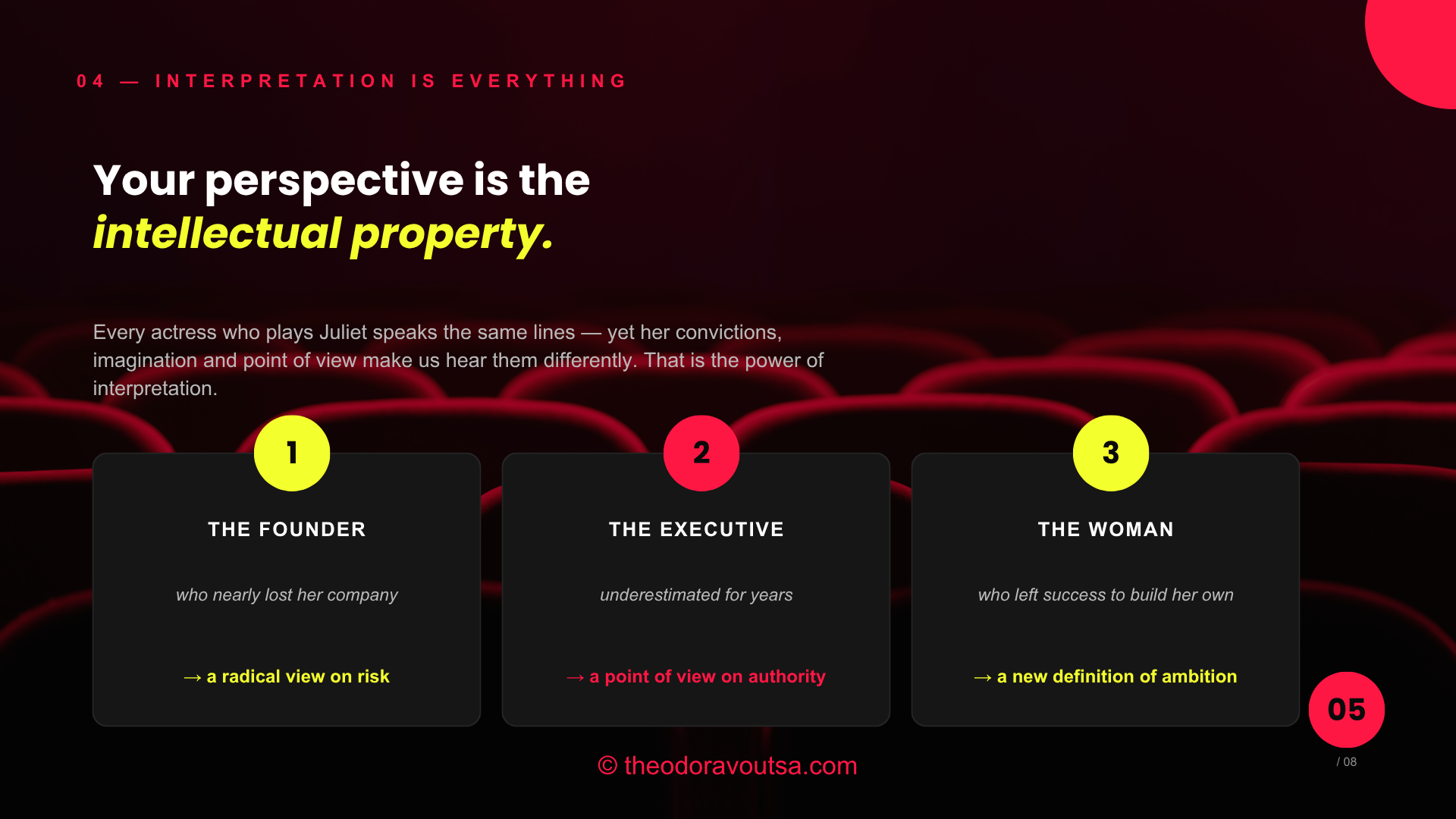
Your perspective is the intellectual property.
The founder who nearly lost her company doesn't just have a story about nearly losing her company.
She may have developed a radically different understanding of risk.
The executive who spent years being underestimated doesn't just have a story about being underestimated.
She may have something important to say about authority.
The woman who left a successful career to build something of her own doesn't just have a career-change story.
She may have developed a perspective on ambition that challenges the conventional definition of success.
That perspective is the intellectual property.
And once you identify it, something changes.
You are no longer simply telling people what happened.
You are giving them a way of seeing.
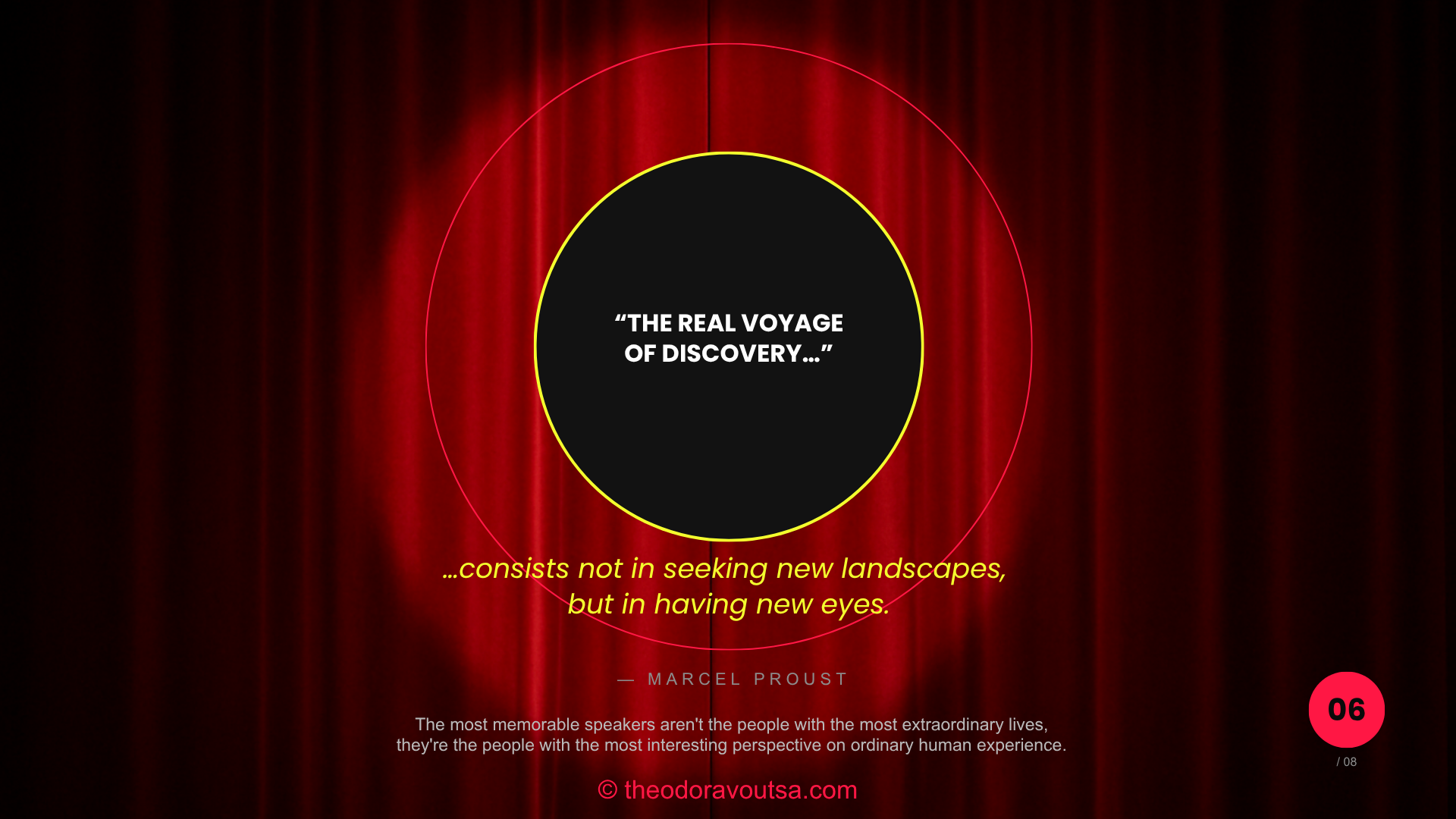
“The real voyage of discovery…”
Proust wrote:
“The real voyage of discovery consists not in seeking new landscapes, but in having new eyes.”
I think great speakers do exactly this.
They don't necessarily take us somewhere we've never been.
They teach us to look at something we thought we understood and see it differently.
That is why the most memorable speakers aren't always the people with the most extraordinary lives.
They are the people with the most interesting perspectives on ordinary human experience.
They give us new eyes.
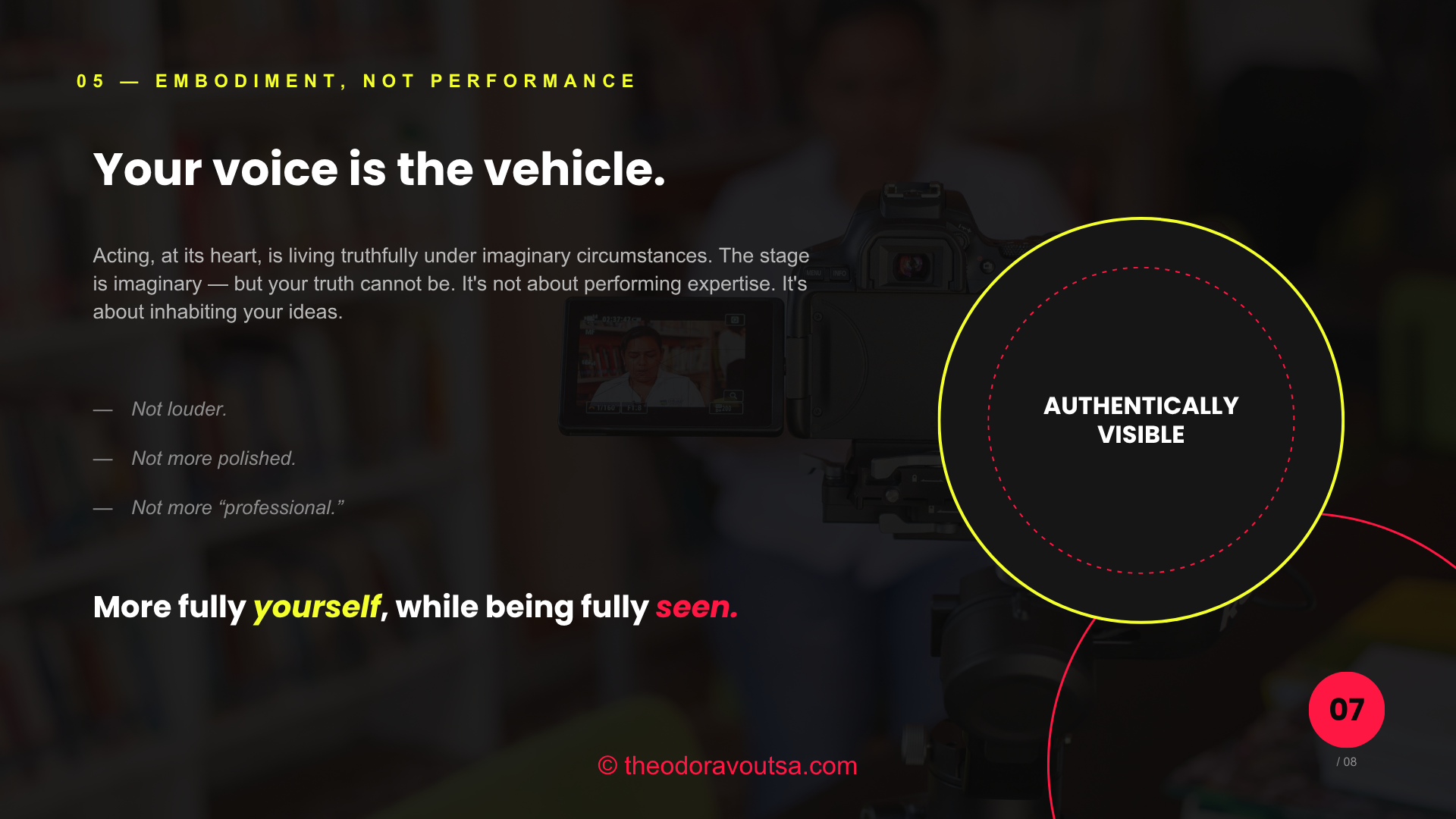
Your voice is the vehicle.
And this is where my work with acting techniques comes in.
Because knowing what you want to say is only half the work.
You also have to be able to embody it.
Acting, at its heart, is not about pretending.
It is about living truthfully under imaginary circumstances.
The stage is an imaginary circumstance.
The camera is an imaginary circumstance.
But your truth cannot be imaginary.
When I coach women, I am not interested in teaching them to perform expertise.
I want them to inhabit their ideas.
To find the thought beneath the words.
To understand what they want their audience to experience.
To use their voice, body, rhythm and presence without losing themselves in the process.
This is what I call Authentically Visible.
Not louder.
Not more polished.
Not more “professional.”
More fully yourself, while being fully seen.
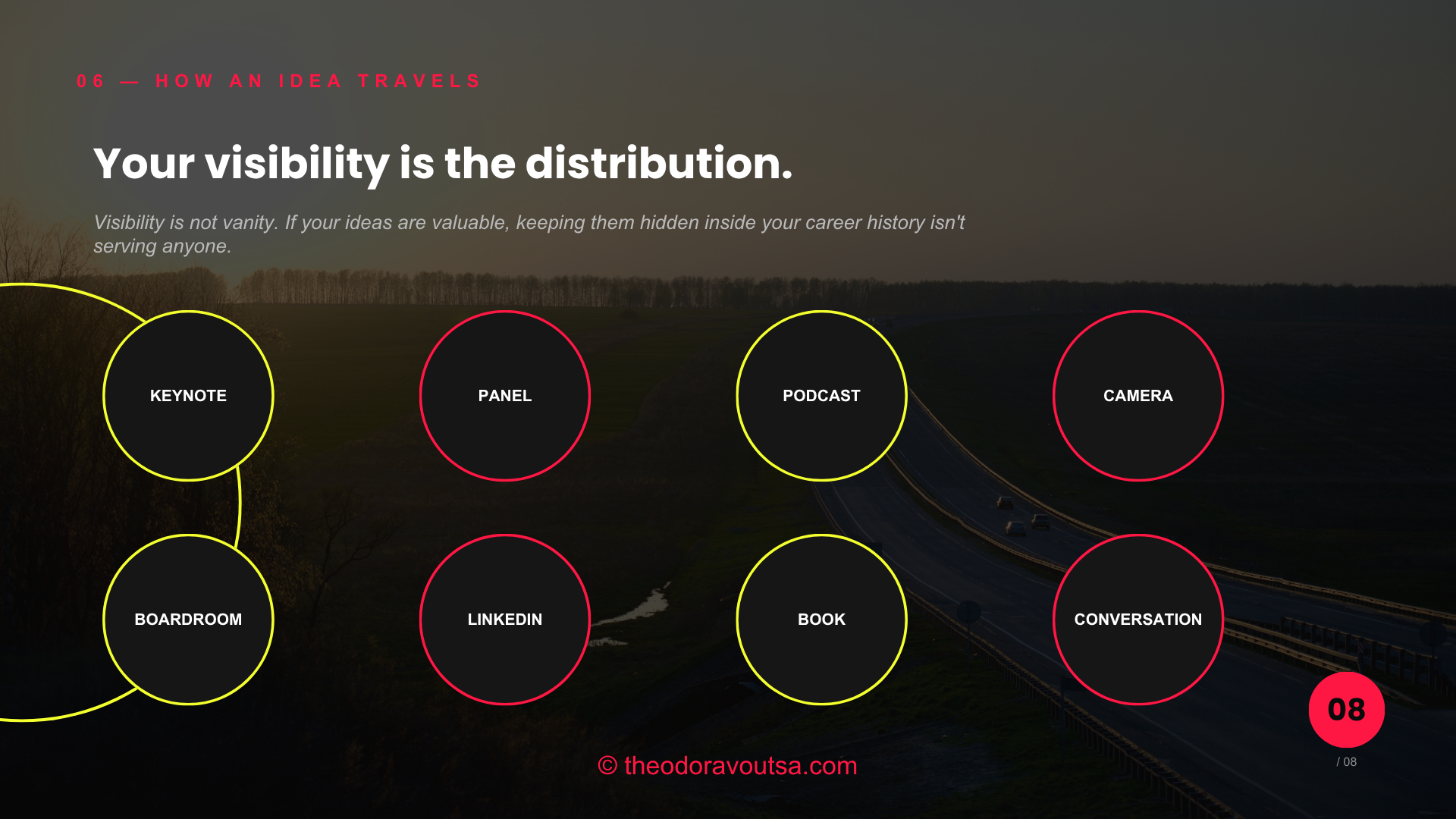
Your visibility is the distribution.
Once you have a point of view, you need somewhere for it to go.
A keynote.
A panel.
A podcast.
A camera.
A boardroom.
A LinkedIn post.
A book.
A conversation.
Visibility is not vanity.
It is how an idea travels.
And if your ideas are valuable, keeping them inside your head or hidden inside your career history, isn’t serving anyone.
Your story can become something other people can learn from.
Something they can remember.
Something they can repeat.
Something they can invite you to speak about.
Something they can pay you for.
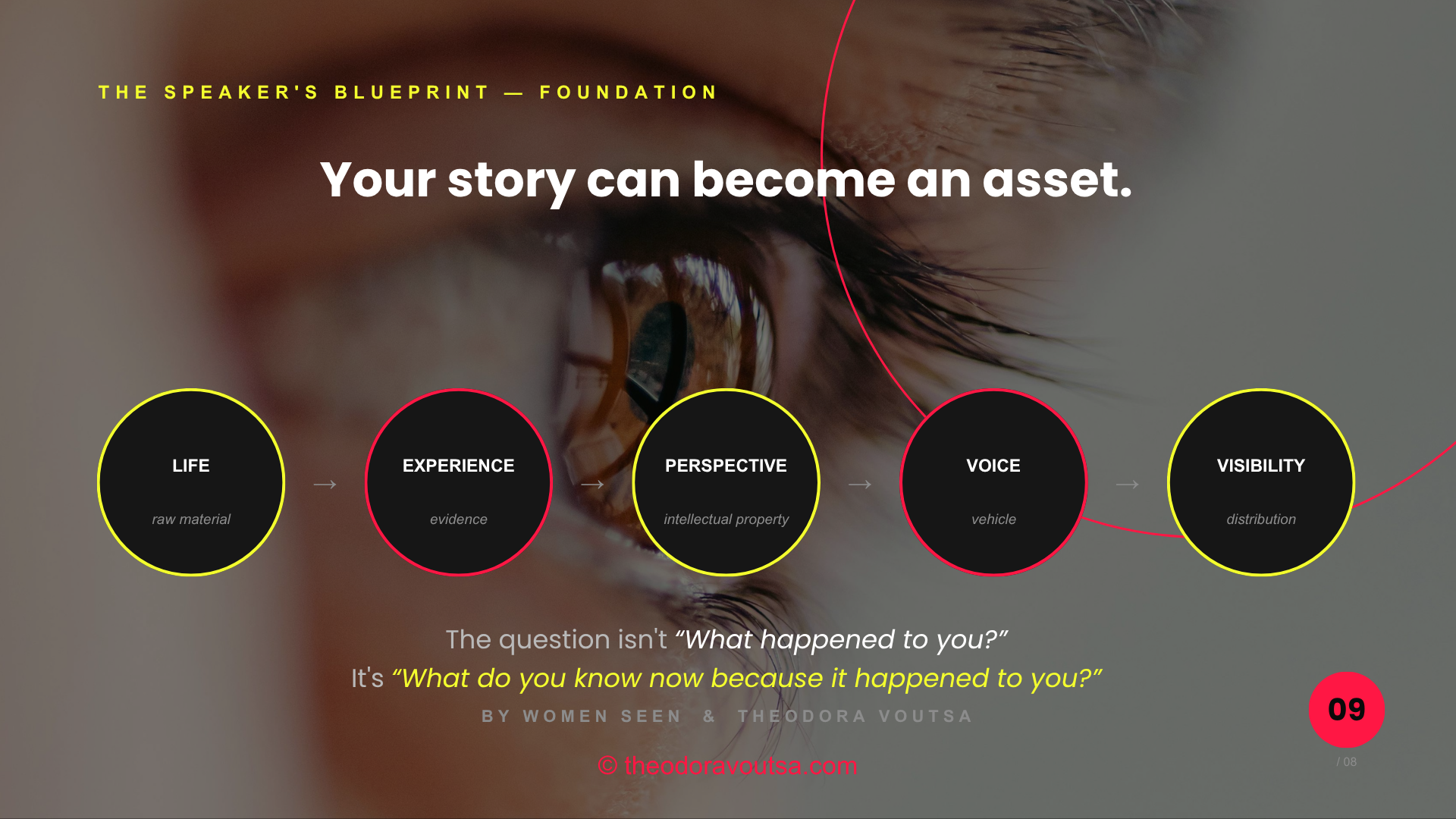
Your life is the raw material.
Your experience is the evidence.
Your perspective is the intellectual property.
Your voice is the vehicle.
Your visibility is the distribution.
And your story can become an asset.
That is the foundation of The Speaker's Blueprint.
Because I don't believe the goal is simply to help women “tell their stories.”
I want to help women extract the ideas hidden inside their stories and give those ideas a voice.
The question isn't:
“What happened to you?”
It is:
“What do you know now because it happened to you?”
And then:
“What could the world know if you shared it?”
That's where we begin.
This is The Speaker's Blueprint.
By Women Seen & Theodora Voutsa